
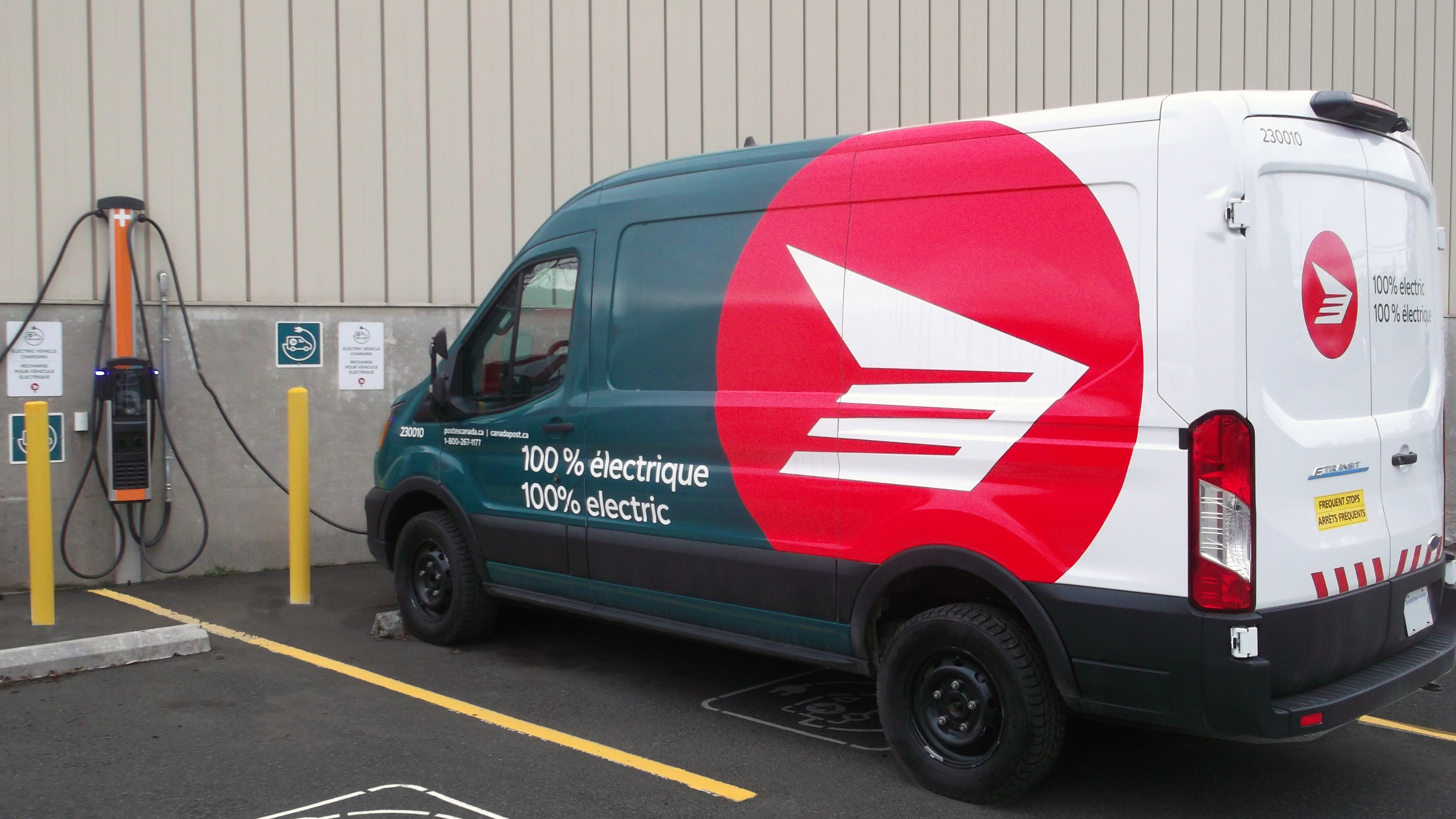
As part of its commitment to achieving net-zero greenhouse gas emissions by 2050, Canada Post Corporation is advancing a national electric vehicle charging network.
Challenge
Planning for fleet electrification at a national scale required a comprehensive assessment of existing electrical infrastructure across a diverse portfolio of secure, operational facilities. The studies needed to identify infrastructure constraints, future capacity requirements, and site-specific challenges that could affect the implementation of charging facilities.
Solution
Engaged by JLL Real Estate, Cion and NORR conducted feasibility studies at more than 90 facilities across Canada to assess existing electrical infrastructure and identify requirements for future charging stations. The investigations evaluated electrical services, transformer capacity, peak demand, and site conditions, while identifying operational and physical constraints that could affect implementation.
Outcome
More than a workplace, the space operates as a living lab for measurable progress. As one of only three projects in Canada—and 17 globally—registered for Zero Carbon Certification™, it demonstrates our leadership in net-zero design while providing a practical model for others to pursue meaningful decarbonization efforts.
The feasibility studies supported Canada Post’s commitment to electrify a fleet of nearly 14,000 vehicles, with targets of 50% electrification by 2030 and 100% by 2040.
Canada Post Corporation (CPC), the primary postal operator in Canada, committed to the electrification of its fleet of nearly 14,000 vehicles, with a target of 50 per cent electric vehicles by 2030, and 100 per cent by 2040. The electrification will help to achieve a more comprehensive goal of achieving net-zero greenhouse gas (GHG) emissions by 2050. To plan for the long-term greening of the commercial fleet, JLL Real Estate, the facility group that manages the CPC portfolio, engaged with Cion and its sister company NORR, to perform feasibility studies at more than 90 locations across Canada.
The feasibility studies are an integral element of the phased planning process to design and build electric vehicle charging stations. The on-site investigations captured existing conditions on a wide range of elements from incoming service ratings and service type (underground or overhead service) to utility transformer size and peak demand from hydro data. Consultative investigations also identified potential physical challenges for upgrades at existing operational and maintenance buildings such as service equipment space limitations, site limitations for underground works and distance to the power grid. As well, information about the source and quality of the power from the existing grid was documented. The objective was to confirm and consult on existing electrical infrastructure to define final requirements for the zero-emission vehicle infrastructure strategy for Canada Post – including infrastructure upgrades for future growth.
The scope of work comprised of feasibility studies for a large portfolio of facilities that are both high security level and operational. In addition, we were awarded design and construction administration packages for three facilities in British Columbia. Close collaboration with CPC, JLL, provincial utilities companies, Cion and NORR was a key success factor.
